Writing /
Rust Is The Future of JavaScript Infrastructure
The Rust Revolution in JavaScript Tooling
If you’ve been paying attention to the JavaScript ecosystem lately, you might have noticed something interesting: Rust is everywhere. From bundlers to linters, compilers to formatters—the tools we use daily are being rewritten in Rust.
The Problem with JavaScript Tooling
Traditional JavaScript tooling, written in JavaScript/TypeScript, has always faced a fundamental limitation: performance. When you’re building a tool that needs to process millions of lines of code, JavaScript’s single-threaded nature and garbage collection overhead become significant bottlenecks.
// Traditional JS bundler - single-threaded processing
async function bundle(files) {;
  const results = [];
  for (const file of files) {
    // Each file processed sequentially
    const result = await processFile(file);
    results.push(result);
  }
  return results;
}
Enter Rust
Rust offers several advantages that make it ideal for developer tooling:
1. Performance
Rust compiles to native code with no garbage collection overhead:
use rayon::prelude::*;

fn bundle(files: Vec<File>) -> Vec<Result> {
    // Process all files in parallel
    files.par_iter()
         .map(|file| process_file(file))
         .collect()
}
2. Memory Safety
No null pointer exceptions, no data races:
// The compiler prevents data races at compile time
fn safe_concurrent_access(data: Arc<Mutex<Vec<String>>>) {
    let mut guard = data.lock().unwrap();
    guard.push("safe!".to_string());
}
3. WebAssembly Support
Rust compiles to WebAssembly, enabling browser-based tools:
#[wasm_bindgen]
pub fn format_code(code: &str) -> String {
    // Format code in the browser with native performance
    formatter::format(code)
}
Tools Built with Rust
Here’s the current landscape of Rust-powered JavaScript tools:
| Tool | Replaces | Speed Improvement |
|---|---|---|
| SWC | Babel | 20x faster |
| Turbopack | Webpack | 700x faster (claimed) |
| Rome/Biome | ESLint + Prettier | 10-20x faster |
| esbuild* | Webpack | 100x faster |
| Oxc | ESLint + TypeScript | 50-100x faster |
| Rolldown | Rollup | Coming soon |
*esbuild is written in Go, but included for comparison
SWC - The Super Fast Compiler
SWC (Speedy Web Compiler) is now used by:
- Next.js - Default compiler since v12
- Vite - Optional React plugin
- Parcel - Built-in transformation
// next.config.js
module.exports = {
  swcMinify: true,  // Use SWC for minification
  experimental: {
    forceSwcTransforms: true,
  },
}
Turbopack - The Webpack Successor
Vercel’s Turbopack aims to be the successor to Webpack:
// next.config.js
module.exports = {
  experimental: {
    turbo: {
      rules: {
        '*.svg': {
          loaders: ['@svgr/webpack'],
          as: '*.js',
        },
      },
    },
  },
}
Biome - One Tool to Rule Them All
Biome (formerly Rome) combines linting and formatting:
{
  "linter": {
    "enabled": true,
    "rules": {
      "recommended": true
    }
  },
  "formatter": {
    "enabled": true,
    "indentStyle": "space",
    "indentWidth": 2
  }
}
The Numbers Don’t Lie
Real-world benchmarks from large codebases:
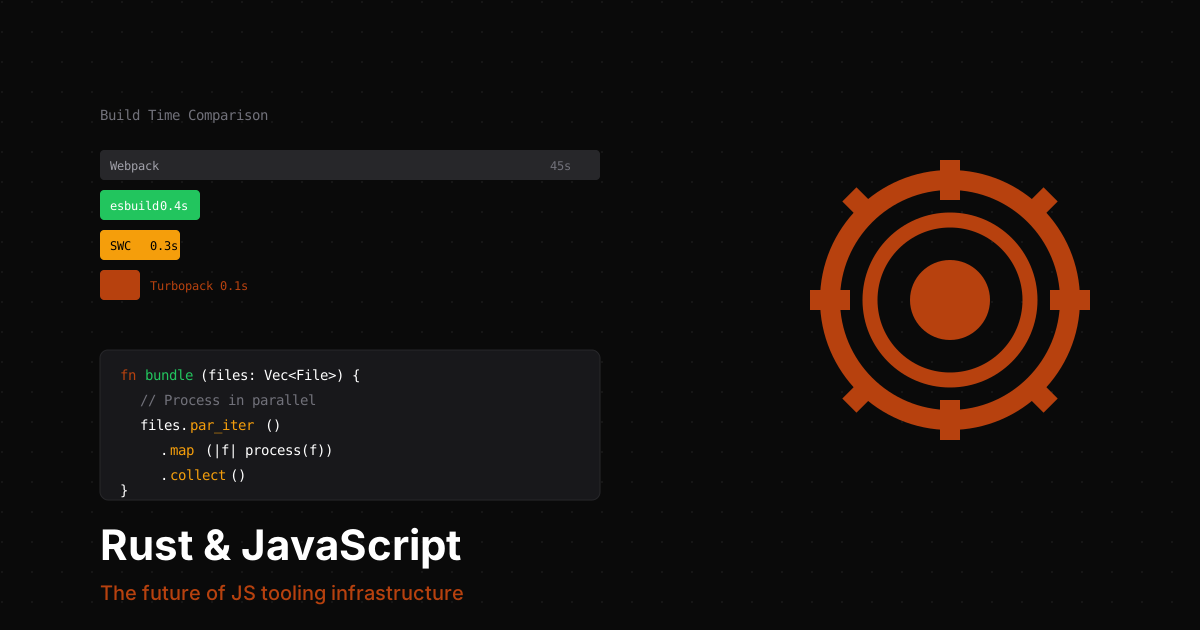
Build Time Comparison (Large React App)
Webpack 5:     45 seconds
esbuild:       0.4 seconds
SWC:           0.3 seconds
Turbopack:     0.1 seconds (incremental)
Linting Time Comparison (100k lines)
ESLint:        12 seconds
Biome:         0.5 seconds
Oxc:           0.2 seconds
Learning Rust as a JS Developer
If you’re interested in contributing to these tools, here’s how to get started:
Key Concepts to Learn
- Ownership and Borrowing - Rust’s unique memory management
- Pattern Matching - Powerful control flow
- Traits - Similar to interfaces in TypeScript
- Error Handling - Result and Option types
Helpful Resources
// Start with the basics
fn main() {
    let greeting = "Hello, Rust!";
    println!("{}", greeting);
}

// Then move to ownership
fn ownership_example() {
    let s1 = String::from("hello");
    let s2 = s1; // s1 is moved to s2
    // println!("{}", s1); // This would fail!
    println!("{}", s2);
}
The Future
The trend is clear: Rust is becoming the lingua franca of JavaScript tooling. Within the next few years, I predict:
- Most major bundlers will be Rust-based
- TypeScript checking will move to Rust (see: stc, ezno)
- Browser DevTools will leverage WASM-compiled Rust
- The npm registry will support Rust binaries natively
Conclusion
You don’t need to become a Rust expert to benefit from these tools. But understanding why this shift is happening helps you make informed decisions about your tooling stack.
The JavaScript ecosystem is getting faster, one Rust rewrite at a time. 🦀